
Pegs and Jokers is a captivating card game blending strategy and luck, enjoyed by players seeking a dynamic experience.
The game’s core revolves around maneuvering pegs across a board, utilizing cards to dictate movement and strategically eliminate opponents’ pegs.
Understanding the nuances of card play, especially regarding Jokers and potential rule variations like Arizona rules, is crucial for success.
What is Pegs and Jokers?
Pegs and Jokers is a shedding-type card game typically played with two to four players (or teams). The primary objective centers around being the first player, or team, to successfully navigate all of their pegs from their starting position to the opposite side of the playing area. This journey is dictated by the cards players hold and strategically deploy during their turn.
The game uniquely combines elements of strategy, requiring players to carefully consider their card plays to maximize peg movement and hinder opponents, with an element of chance, as the cards dealt influence available actions. Jokers serve as wild cards, offering versatile movement options and disrupting opponent’s plans.
A key aspect involves understanding and potentially utilizing rule variations, such as the popular “Arizona Rules,” which introduce additional complexities and strategic depth. These rules often involve options for discarding without moving, or splitting card values between pegs.
Historical Background of the Game
The precise origins of Pegs and Jokers remain somewhat shrouded in mystery, lacking a definitively documented creation story. However, the game is widely believed to have emerged in the mid-20th century, gaining traction as a popular pastime within family circles and social gatherings. Its roots likely stem from earlier shedding-type card games, evolving through informal adaptations and regional variations over time.
Unlike many classic card games with centuries-old lineages, Pegs and Jokers’ history is largely oral, passed down through generations of players. The introduction of the Joker as a central game element suggests a period after the standardization of playing card decks including this card.
The game’s spread was facilitated by its simple ruleset and accessibility, requiring only a standard deck of cards and readily available pegs or markers. The Arizona Rules variation, a significant addition, further contributed to its enduring appeal.
Popularity and Regional Variations
Pegs and Jokers enjoys enduring popularity as a casual, yet strategically engaging, card game, particularly within North America. While not achieving the widespread recognition of games like Poker or Bridge, it maintains a dedicated following, often passed down through families. Its appeal lies in its blend of luck and tactical decision-making, making it accessible to players of varying skill levels.
Regional variations are a defining characteristic of Pegs and Jokers. The most prominent is undoubtedly the “Arizona Rules” set, which introduces the option to discard without moving, adding a layer of complexity.
Other house rules frequently emerge, impacting aspects like Joker usage or peg movement restrictions. These localized adaptations contribute to the game’s dynamic nature, ensuring a unique experience depending on the playing group and location.

Game Components
Pegs and Jokers requires a standard 52-card deck, plus Jokers, and a set of pegs – typically 16 to 20 – in distinct colors for each player or team.
The Deck of Cards
Pegs and Jokers fundamentally relies on a standard 52-card deck, representing the engine for peg movement and strategic plays. However, the inclusion of Jokers is absolutely essential, elevating the game’s dynamic and introducing elements of unpredictability and powerful maneuvers.
Each card’s numerical value directly corresponds to the number of spaces a peg can be moved along the playing surface. Suits hold no inherent value; only the number matters. Aces typically function as a ‘1’, offering minimal movement, while higher cards like Kings and Queens allow for substantial advances.
The Jokers, acting as wild cards, grant players exceptional flexibility. They can be utilized to mimic any numerical value, enabling significant strategic advantages, or to perform special actions depending on the specific rule set being employed – such as swapping peg positions or removing opponent’s pegs; A well-timed Joker play can dramatically alter the game’s trajectory.
Pegs – Quantity and Color
Pegs and Jokers utilizes pegs as the central game pieces, representing each player’s progress across the playing surface. Typically, the game accommodates two to four players, with each player receiving an equal number of pegs to begin. A common configuration involves ten pegs per player, ensuring a balanced starting position and prolonged gameplay.
Color differentiation is crucial for distinguishing between players’ pegs; Commonly, sets of pegs come in four distinct colors – red, blue, green, and yellow – allowing for easy identification during fast-paced turns. The initial arrangement of these pegs is vital, usually placed in a row on opposite sides of the playing area.
The pegs themselves are often simple, cylindrical pieces made of plastic or wood. Their primary function is to be moved strategically based on card play, with the ultimate goal of navigating them to the opponent’s starting position.
The Game Board (if applicable)
Pegs and Jokers doesn’t always require a dedicated game board, contributing to its portability and accessibility. Many variations are played directly on a flat surface, utilizing an imaginary or simply marked track for peg movement. However, commercially available sets often include a specifically designed board to enhance the gameplay experience.
These boards typically feature a series of numbered spaces, forming a pathway for the pegs to traverse. The number of spaces varies, influencing the game’s length and strategic complexity. Some boards incorporate special spaces that trigger unique actions or penalties, adding an extra layer of challenge.
When a board is used, it visually defines the playing area and provides a clear indication of peg positions and progress. The board’s design can range from simple linear tracks to more elaborate, winding paths, catering to different player preferences.

Setting Up the Game
Initial peg placement and card dealing are key steps, establishing the foundation for strategic gameplay. Determining the first player initiates the exciting challenge ahead.
Initial Peg Placement
Pegs are strategically positioned at the start, typically arranged in two rows facing each other, forming the starting points for each player or team’s advancement. The exact number of pegs varies, often with four pegs per side when playing with two teams of two players each.
These pegs represent each player’s or team’s pieces, and their initial placement is crucial as it dictates the starting positions for maneuvering across the playing surface. Careful consideration should be given to the arrangement, as it influences early game strategy and potential defensive or offensive positions.
Players must ensure pegs are securely placed and clearly distinguishable, often utilizing different colors to differentiate between opposing sides. Proper initial setup is fundamental to a fair and enjoyable game of Pegs and Jokers, setting the stage for tactical card play and strategic peg movement.
Dealing the Cards
Card distribution is a pivotal step in initiating gameplay, typically involving a standard 52-card deck, though some variations may incorporate additional Jokers. The dealer shuffles the deck thoroughly before distributing cards to each player, ensuring randomness and fairness.
The number of cards dealt per player varies depending on the specific ruleset being employed, but a common practice is to deal seven cards to each participant. Cards are usually dealt one at a time, face down, in a clockwise direction around the table.
Players should keep their hands concealed from opponents, maintaining secrecy regarding their available cards. Once all cards are dealt, players examine their hands, preparing to utilize them strategically to move their pegs and disrupt their opponents’ progress.
Determining the First Player
Establishing the initial player is crucial for a smooth game start, and several methods are commonly employed to determine who goes first. A frequent approach involves drawing cards, with the player holding the highest-ranking card – often the highest spade – taking the inaugural turn. Alternatively, players might roll dice, with the highest roller gaining the first-player advantage.
Some groups opt for a simpler method, such as assigning the first player based on alphabetical order of names or a pre-determined rotation. Consistency in the chosen method is key to avoid disputes.
Regardless of the technique, the selected player begins the game by initiating the first card play, setting the stage for strategic peg movement and competitive gameplay. This initial move can significantly influence the early stages of the game.

Gameplay Mechanics
Core gameplay centers on strategically playing cards to move pegs, aiming to eliminate opponents’ pieces or reach the opposite side of the board.
Jokers introduce wild card dynamics.
Basic Card Play Rules
Card play in Pegs and Jokers typically proceeds in a clockwise direction, with players taking turns to play one card per turn. The primary objective of each card played is to move one of your team’s pegs a corresponding number of spaces along the playing surface. Numbered cards directly correlate to the number of spaces a peg can advance.
Players must adhere to the movement restrictions; pegs can generally only move forward, and cannot jump over other pegs. If a player cannot legally move any of their pegs with a card in their hand (excluding Jokers), they may discard the card without effect. However, this is often restricted by specific rule sets, like Arizona rules, where discarding without movement is only permitted if no legal peg movement is possible.
Jokers serve as versatile wild cards, capable of representing any numerical value desired by the player, offering strategic flexibility. Careful consideration of card values and potential peg movements is essential for effective gameplay.
Moving Pegs with Numbered Cards
Numbered cards are the engine of peg movement in Pegs and Jokers. When a player lays down a numbered card – say, a ‘5’ – they must advance one of their team’s pegs exactly five spaces forward along the designated path. Movement is generally unidirectional, meaning pegs progress towards the opposite side of the playing area and cannot move backwards.
A crucial rule dictates that pegs cannot jump over other pegs, whether belonging to your team or opponents. This creates strategic blocking opportunities and necessitates careful planning of each move. Players must ensure a clear path exists for the intended peg before playing a numbered card.
If a peg reaches the end of the path, it remains there, effectively removed from active play. Strategic positioning and anticipating opponent’s moves are key to maximizing the effectiveness of numbered card plays.
The Role of Jokers
Jokers are the wild cards of Pegs and Jokers, introducing a significant element of unpredictability and strategic depth. Typically, a Joker allows a player to move any of their team’s pegs any number of spaces, offering unparalleled flexibility. This can be used to quickly advance a peg, strategically block an opponent, or escape a precarious position.
However, the use of Jokers is often governed by specific rules. Some variations permit a Joker to be played as any numbered card, while others restrict its use to a maximum number of spaces. A key strategic consideration is when to deploy a Joker – saving it for a crucial moment or using it to gain an immediate advantage.
Effective Joker play often hinges on anticipating opponent’s moves and maximizing its impact on the board state.

Advanced Rules and Strategies
Mastering Pegs and Jokers involves understanding Arizona rules, strategic discarding, and effective team coordination to outmaneuver opponents and secure victory.
Splitting Cards (Arizona Rules)
Arizona Rules introduce a compelling dynamic: the ability to “split” a card’s movement between two of your team’s pegs. This is particularly potent with higher-numbered cards, like sevens, allowing for significant strategic advancement.
For instance, if you hold a seven and have two pegs needing movement, you can move one peg four spaces and the other three, or any other combination totaling seven. This flexibility is a cornerstone of advanced play.
However, a crucial clarification exists: you cannot split a seven’s movement to benefit both your peg and an opponent’s. The split must exclusively aid your team’s progress. Furthermore, discarding without moving is permissible only when no legal card play exists to move any of your team’s pegs, excluding Jokers.
This rule adds a layer of complexity, demanding careful consideration of peg positioning and card usage to maximize efficiency and hinder opposing team’s advancement.
Discarding Without Moving
A frequently debated aspect of Pegs and Jokers, particularly under Arizona Rules, concerns discarding a card without actually moving a peg. The core principle is that discarding without movement is a strategic option, but it’s not freely available.
You are permitted to discard a card – excluding a Joker – only when you genuinely lack a legal play to move any of your team’s pegs. This means thoroughly assessing the board and your hand before resorting to a discard.
Simply wanting to save a card for a later turn doesn’t justify discarding without movement. The inability to make a valid move is the sole condition. This rule prevents stalling tactics and encourages active gameplay.
Understanding this nuance is vital, as improper discarding can leave your team at a disadvantage, especially when opponents have more maneuvering options available.
Team Play Strategies
When engaging in team Pegs and Jokers, coordinated strategy becomes paramount. Effective communication, even non-verbal, is key to maximizing your collective advantage. Prioritize protecting your partner’s pegs while simultaneously advancing your own towards the opposite side.
Consider sacrificing a peg strategically to open pathways for your teammate, or to block an opponent’s progress. Don’t solely focus on individual advancement; a synchronized push is far more effective.
Discuss potential card plays and their implications with your partner before committing. Anticipate opponent’s moves and plan accordingly. Remember, a well-timed Joker can dramatically shift the game’s momentum for the entire team.
Successful team play hinges on mutual support and a shared understanding of the board’s evolving dynamics.

Specific Rule Variations
Pegs and Jokers exhibits diverse rule adaptations, notably “Arizona Rules,” impacting gameplay significantly. These variations introduce unique strategic layers and challenges for players.
Arizona Rules in Detail
Arizona Rules dramatically alter Pegs and Jokers, introducing a key allowance: discarding without moving a peg. This is permissible only when a player holds no playable cards – excluding Jokers – capable of advancing any of their team’s pegs.
This rule prevents forced plays that could strategically disadvantage a team. Furthermore, Arizona Rules permit splitting a seven’s movement between a player’s peg and their partner’s peg, offering enhanced tactical options.
This split allows for coordinated advancement and increased control over peg positioning. However, careful consideration is needed, as misjudging the split can hinder progress. Mastering these nuances is vital for competitive play under Arizona Rules, demanding strategic foresight and adaptability.
Other Common House Rules
Beyond Arizona Rules, Pegs and Jokers frequently incorporates diverse house rules, enriching gameplay. Some variations dictate that a Joker can be used to ‘freeze’ an opponent’s peg, temporarily preventing its movement, adding a defensive layer.
Another common adjustment involves modifying the penalty for landing on an occupied space; instead of immediate removal, a peg might be sent back to its starting position.
Certain groups allow players to draw replacement cards after discarding, maintaining hand size and momentum. These modifications often stem from a desire to balance luck and strategy, or to accelerate the game’s pace. Always clarify house rules before starting a game to ensure fair and enjoyable competition.
Impact of Rule Variations on Gameplay
Rule variations in Pegs and Jokers significantly alter the strategic landscape. Arizona Rules, permitting discarding without movement when no legal peg moves exist, dramatically increases defensive play and prolongs matches.
Allowing a seven to split between team pegs fosters collaborative tactics, but can also lead to complex decision-making regarding optimal peg advancement.
House rules, like freezing pegs with Jokers, introduce tactical blocking opportunities, shifting focus from pure offense to strategic defense. These changes impact risk assessment, card management, and overall game tempo. Understanding how each variation affects gameplay is crucial for adapting strategies and maximizing chances of victory.

Winning the Game
Victory in Pegs and Jokers is achieved by strategically eliminating all opponent pegs or successfully maneuvering your pegs to the opposite side of the board.
Eliminating Opponent’s Pegs
A primary path to victory in Pegs and Jokers involves skillfully eliminating your opponent’s pegs from the board. This is accomplished by landing your own peg on a space occupied by an opposing peg through precise card play and strategic movement.
When a peg successfully captures another, the captured peg is removed from the game, reducing the opponent’s presence and bringing you closer to overall dominance. Careful consideration must be given to each move, weighing the potential for captures against the risk of exposing your own pegs to attack.
Players often prioritize capturing opportunities, but a balanced approach is key. Focusing solely on elimination can leave your own pegs vulnerable. Mastering the art of both offense and defense is crucial for consistently removing opponent pegs and securing a winning advantage.

Reaching the Opposite Side
An alternative victory condition in Pegs and Jokers centers around successfully maneuvering one or more of your pegs to the opposite side of the game board. This requires careful planning and consistent forward progress, navigating obstacles and avoiding capture by opposing pegs.
The specific rules regarding reaching the opposite side can vary depending on the house rules in play. Some variations require a peg to land exactly on the final space, while others allow it to pass it. Understanding these nuances is vital for strategic gameplay.
Successfully getting a peg across often necessitates a combination of strategic card play, calculated risks, and a degree of luck. It’s a challenging but rewarding path to victory, offering a different approach than solely focusing on eliminating opponent pegs.
Determining the Winner
The victor in Pegs and Jokers is typically determined by one of two primary conditions, often agreed upon before the game begins. The most common method involves completely eliminating all of your opponent’s pegs from the board through strategic captures and skillful card play.
However, as an alternative, a player can also win by successfully moving a predetermined number of their pegs to the opposite side of the playing surface. This adds a layer of strategic depth, encouraging both offensive and defensive maneuvers.
In team play, the winning team is the first to achieve either of these conditions with all of their combined pegs. Clear communication and coordinated strategy are essential for team success, ensuring a unified approach to victory.

Legal Considerations & Clarifications
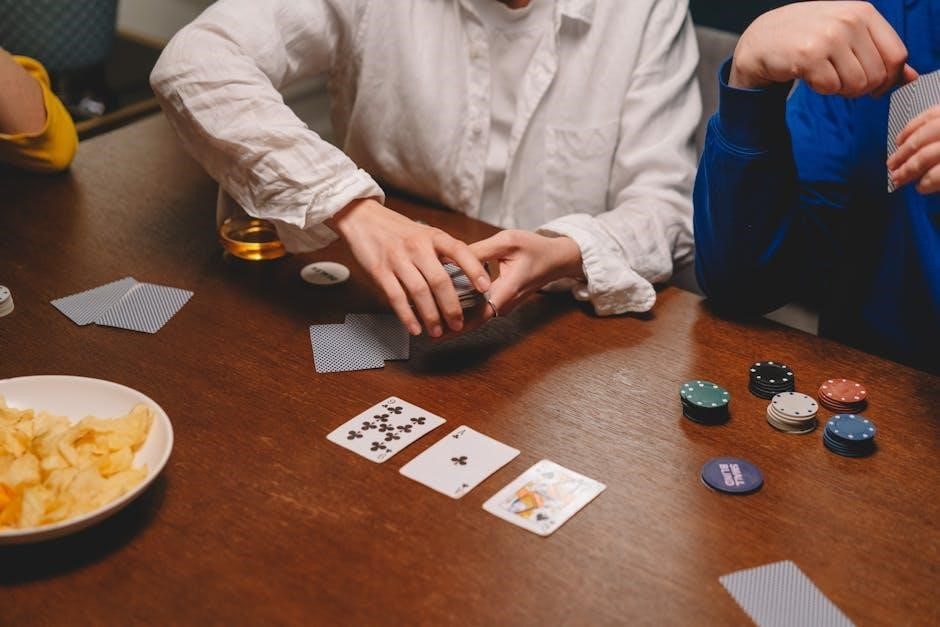
Clarifying rules, like splitting a seven, is vital; Arizona rules permit discarding without moving if no legal peg movement is possible with available cards.
Legality of Splitting a Seven
The legality of splitting a seven card is fundamentally tied to the rule set being employed, specifically whether Arizona Rules are in effect. Without Arizona Rules, a seven must move a single peg the full seven spaces. However, under Arizona Rules, the seven gains a unique flexibility.
Arizona Rules explicitly allow a player to divide the seven’s movement between two of their team’s pegs. This split can be any combination totaling seven spaces – for example, moving one peg four spaces and another three. This strategic option dramatically alters gameplay, introducing more tactical depth and opportunities for complex maneuvers.
It’s crucial to establish before the game begins whether Arizona Rules are being used, as this directly impacts the legality and optimal play of a seven card. Failure to clarify can lead to disputes and frustration during gameplay. Always confirm the agreed-upon ruleset to ensure fair and enjoyable play.
Discarding Rules Clarification
Discarding in Pegs and Jokers isn’t simply about getting rid of unwanted cards; it’s strategically linked to peg movement. Generally, a player must play a card that moves a peg if a legal move is available. However, a critical exception exists, particularly under Arizona Rules.
You are permitted to discard without moving a peg only when unable to play a card (excluding Jokers) that can legally move any of your team’s pegs. This prevents players from being stuck with unplayable cards while still adhering to the core principle of advancing pegs.
Jokers, being wild cards, always offer a potential move, so discarding while holding a Joker is typically prohibited. Clarifying this rule upfront avoids confusion and ensures players understand the conditions under which discarding is legitimately allowed.
Understanding Team Peg Movement
Team play in Pegs and Jokers introduces a collaborative dimension to the game, demanding strategic coordination between partners. When playing as a team, any card played can move any of your team’s pegs, regardless of who initially played the card.
This shared movement capability is crucial for maximizing efficiency and protecting vulnerable pegs. Partners must communicate effectively to determine the optimal peg to move, considering both offensive and defensive strategies. A well-timed move by one partner can significantly benefit the other.
Remember, the goal remains eliminating opponent’s pegs, but achieving this requires synchronized team effort. Successful teams leverage this shared movement to create advantageous positions and control the board.
Leave a Reply
You must be logged in to post a comment.